Local development, trusted HTTPS
No public exposure. No self-signed certificate warnings.
A self-hosted platform to build and deploy apps, and control routing across your connected machines. Let your agents handle deployments while you monitor and manage everything from one console.
sudo bash -c "$(curl -fsSL meshploy.com/install.sh)" # Install Meshploy on my serverpaste into Claude Code, Codex or your own agent Fetch your code from Git. Build on your own machine. Publish the image to your registry, then run it on a cloud node—all connected over your private mesh.
Your service can stay on its office machine. Point a domain at your gateway and route requests across the mesh to where that service already runs.
Increase an application’s replica count and let Kubernetes schedule it across eligible cloud workers. Your gateway keeps providing the application’s public entry point.
Meshploy is an open-source, self-hosted application platform. It brings deployment, private networking, routing, and resource management together across your servers—with a web console, CLI, API, and MCP tools for AI agents.
Community is open source under Apache-2.0. Talk to us about Enterprise availability and your organisation’s requirements.
Already running something useful? Discover services on your nodes and route traffic to them. Deploy new applications alongside what you already have.
A real domain and a browser-trusted Let’s Encrypt certificate for your local service—accessible only over your private mesh.
Private Let’s Encrypt certificates require DNS delegation. How it works ↗
No public exposure. No self-signed certificate warnings.
Public HTTPS for your apps and external webhooks.
Keep services inside the cluster when they need no external endpoint.
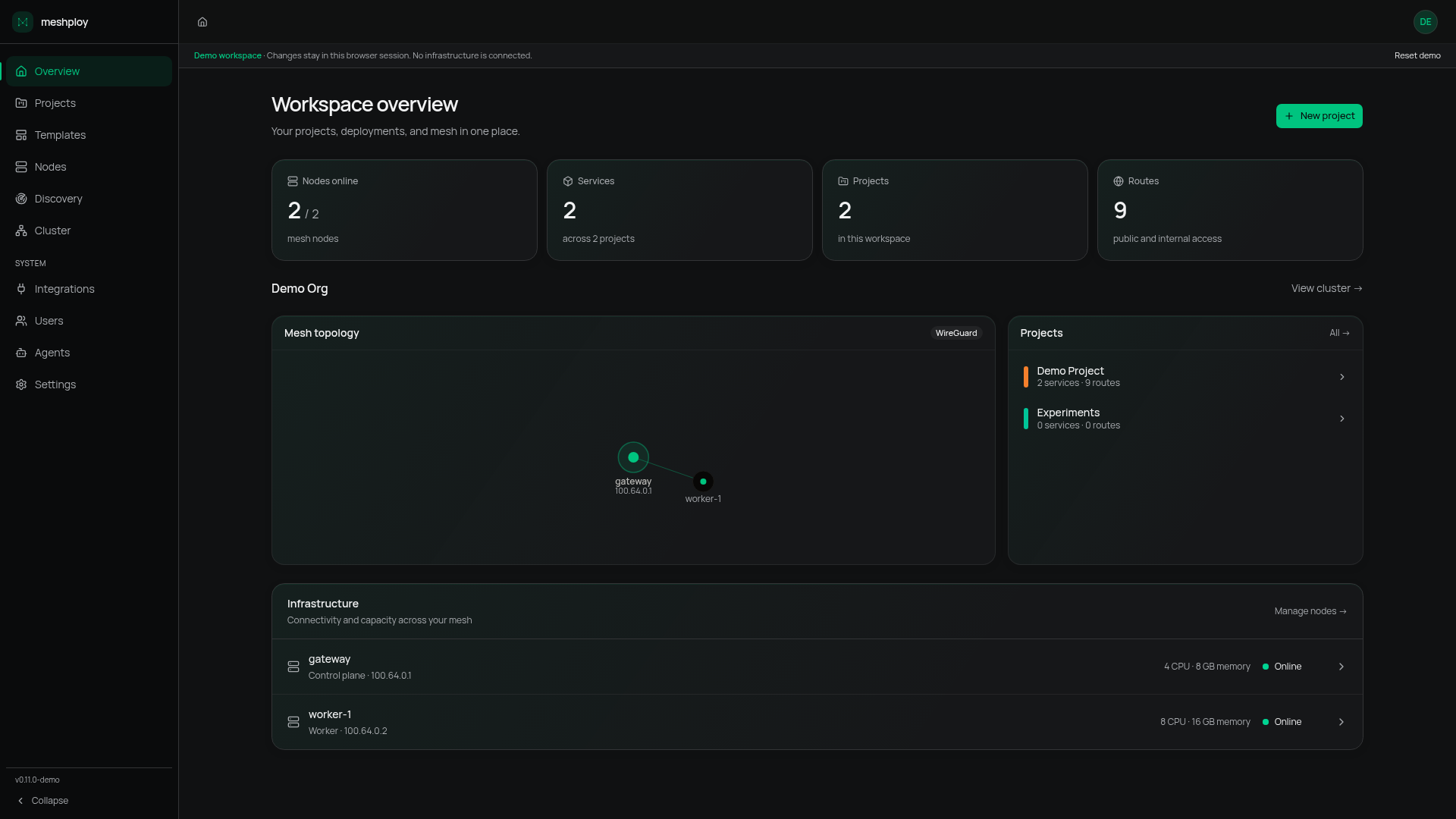
Explore visually, work from your terminal, or connect your coding agent. Each interface works with the same Meshploy resources.
# One application definition. Your infrastructure.
$ meshploy apply -f compose.yml

  ✓ Project resources reconciled
  ✓ Application configuration applied
  ✓ Routes configured

# Inspect rollout status and logs with the CLI
$ meshploy --help
▊
Deploy the inventory app in my team’s project. Keep Postgres private.
I’ll inspect the project, apply the application configuration, and check its deployment.
Give your coding agent a deployment destination. Connect through MCP, grant access to a project, and let it work with Meshploy’s deployment and management tools.
Deploy the inventory app in my team’s project. Keep Postgres private.
I’ll inspect the project, apply the application configuration, and check its deployment.
Inspect rollout history and logs when you need to understand a change.
Grant people and agents access to the projects and resources they need.
Configure database backup schedules and work with saved snapshots.
Start with where your apps run, how your machines connect, and what you want to operate yourself.
Deploy applications on the provider’s platform, using its infrastructure and deployment workflows.
Run on machines you own or rent, across providers and locations. You operate the hosts; Meshploy coordinates deployments and routing.
Manages Docker deployments on individual servers over SSH. For supported multi-server deployments, traffic distribution is configured separately.
Makes connected machines work as one deployment cluster. Meshploy handles Kubernetes orchestration and gateway routing, so you manage apps without managing Kubernetes directly.
Deploy apps with Docker and Swarm, then configure their domains and automatic HTTPS through Traefik.
Manage routes and apps as independent resources. Connect routes to K3s workloads or existing services over the mesh, with Caddy handling on-demand TLS. Control traffic independently of deployment, without managing Kubernetes directly.
Deploy Compose applications across a private mesh without Kubernetes or Swarm. Its decentralised design keeps healthy replicas running when a machine fails.
Build, deploy, and manage apps through a console, CLI, or AI agent—without managing Kubernetes directly. Meshploy handles the underlying K3s orchestration, networking, and routing.
Currently uses a single gateway, which is a single point of failure. Gateway high availability is planned.
Meshploy is software you install on infrastructure you own or rent. You provide and maintain the servers; Meshploy brings deployment, networking, and management together.
You can start with one server and connect more as your needs grow. Different node roles let you choose how machines participate in your infrastructure.
Yes. Meshploy provides MCP tools and agent identities. Connect a compatible client, give its agent the appropriate access, and use it to manage resources and deployments.
Yes. Discovery surfaces reported endpoints and containers on your nodes. Routes can point to supported existing services without first redeploying them in Meshploy.
You choose exposure through service access settings and routes. Mesh access keeps a service reachable on the private network; public routes expose the selected endpoint through the gateway.
Meshploy Community is licensed under Apache-2.0. You can inspect the source, self-host it, and contribute on GitHub.
Bring a server. Create a project. Build something useful.